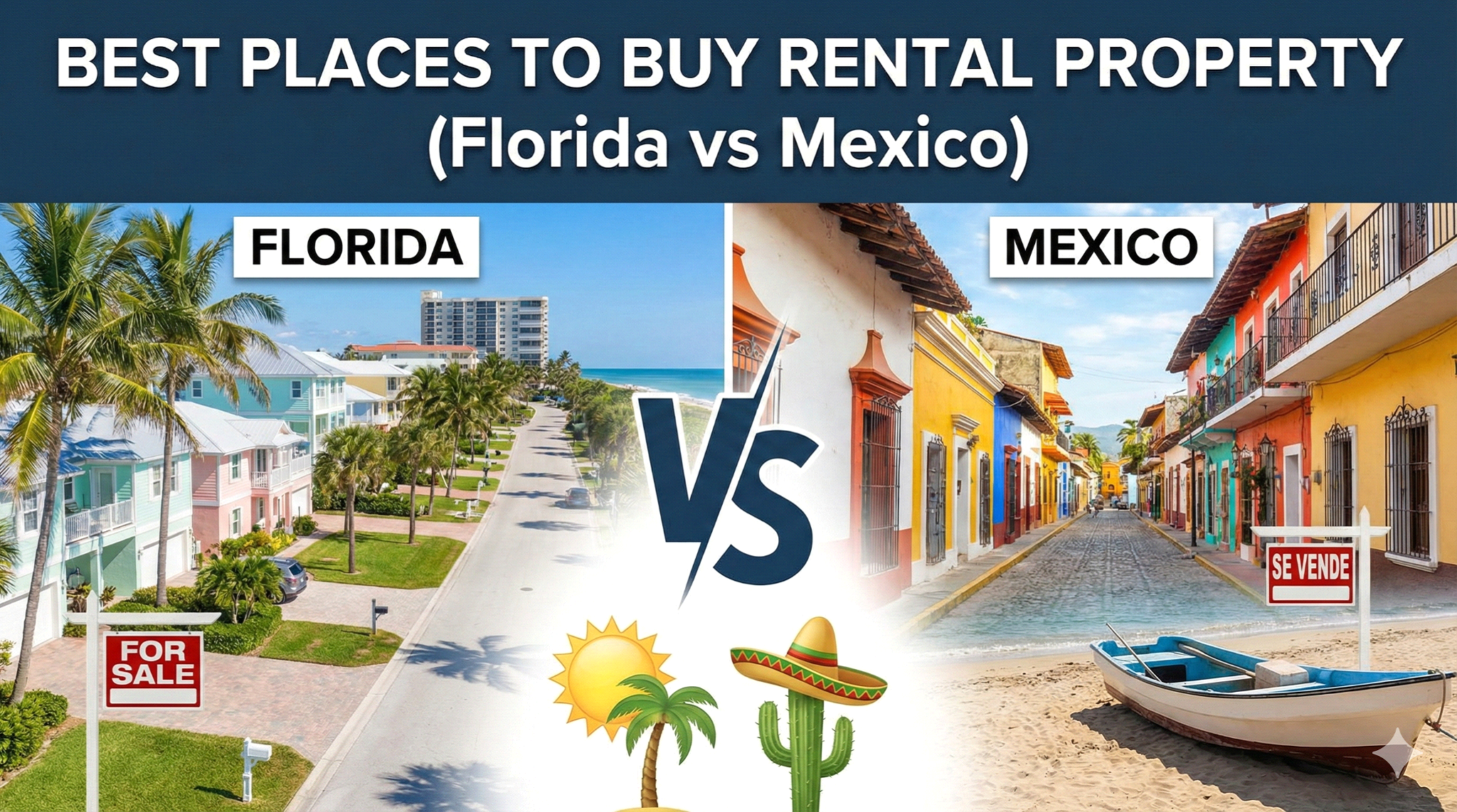
Best Places to Buy Rental Property (Florida vs Mexico)
If you want a clean answer in 2026, stop asking “what’s the best place?” and start asking “best place for what strategy?”
A market can be amazing for short-term rentals and terrible for long-term cash flow. Another market can be boring but stable, which is exactly what many landlords actually want.
So I’m going to break this down by strategy, then list places that make sense in each country, plus the risks that can quietly wreck your returns.
Step 1: Pick your rental strategy first
Strategy A: Long-term rentals (12-month leases)
This is usually the simplest path for most investors. You want:
- steady tenant demand (jobs, population growth, universities, healthcare)
- manageable operating costs
- fewer regulatory surprises than short-term rentals
Strategy B: Short-term rentals (Airbnb style)
This can earn more, but it is less predictable. You want:
- strong year-round tourism or events
- clear local rules (and the ability to comply)
- higher operating budget (cleaning, furnishing, turnovers, and usually higher wear and tear)
Strategy C: Mid-term rentals (30+ days, traveling nurses, relocations)
Often the best compromise in 2026 if you want flexibility without constant guest turnover.
Florida: where rentals make sense in 2026
Florida has demand. Tourism is real and huge. Visit Florida reported 34.4 million visitors in Q2 2025.
But Florida also has costs that can surprise you, especially insurance.
Best Florida picks for long-term rentals
These picks tend to work best when you buy for “boring demand,” not hype.
- Jacksonville: Often more affordable than the south end of the state, with steady job-driven demand. Good for landlords who want durability over glamour.
- Tampa: Strong renter demand, but do your homework on neighborhoods and property condition. New supply has cooled rent growth in parts of Florida, so underwriting has to be conservative.
- Orlando: Works for long-term when you target workforce and family rentals in solid school zones and commuter areas. For pure tourism STR, it becomes a different game (more on that next).
Best Florida picks for short-term rentals
Florida has state-level rules that limit what local governments can restrict about “duration/frequency” of vacation rentals, but locals can still regulate many operational aspects. The statute language on preemption is in Florida law.
If you want STR, focus on areas where tourism is consistently strong and you can comply with local requirements.
- Miami: Big demand, but also more competition and more rule sensitivity depending on the exact area and building. Condo rules can be stricter than city rules.
- Orlando: One of the most obvious STR markets because demand is driven by attractions and family travel. But you must run numbers with conservative occupancy.
Florida risk that affects “best place” more than people admit
Insurance and flood risk can change the entire deal. Bankrate’s state-by-state insurance comparison shows Florida among the highest average premiums.
If a property is in a Special Flood Hazard Area and you use a federally backed mortgage, flood insurance is mandatory.
That means two identical properties can produce totally different cash flow depending on wind, roof condition, and flood zone.
Bottom line for Florida: the best places are the ones where your total operating costs stay predictable enough that you are not relying on perfect rent growth to survive.
Mexico: where rentals make sense in 2026
Mexico can be attractive for rentals because:
- tourism-driven STR demand is huge in the right areas
- purchase prices can be lower than many US markets
- the lifestyle factor attracts long-stay guests in certain cities
But Mexico has two big “gotchas” investors need to respect:
- foreign ownership rules in coastal and border “restricted zones”
- short-term rental rules that vary by state and city and are evolving
First: understand the ownership structure near the beach
Foreign individuals generally cannot hold direct title in the restricted zone and use a bank trust called a fideicomiso. A Mexican business law firm overview explains how fideicomiso works and that it typically runs 50 years and can be renewed.
This is not “bad,” but it is different. You need the right attorney and you should budget the trust-related fees.
Best Mexico picks for short-term rentals (tourism-driven)
- Cancun and the broader Riviera Maya: Tourism demand is the entire engine here. The regulatory side matters though. Quintana Roo has compliance requirements like tourism registry enrollment for lodging providers, which attorneys highlight in compliance guides.
- Playa del Carmen: Strong demand, but watch the direction of local licensing. Recent reporting indicates the city is moving toward requiring municipal licenses and potentially limiting where STRs operate.
- Tulum: Can do well when executed properly, but it is more sensitive to seasonality and oversupply pockets. You need conservative occupancy assumptions.
Best Mexico picks for mid-term rentals (30+ days)
- Mexico City: Mid-term can be a smarter play here than pure STR because regulation has tightened on short-term rentals. Legal commentary notes Mexico City has amended provisions to regulate STRs on digital platforms.
Some summaries of the reform also describe an occupancy or day-limit approach, and the policy environment is tied to housing pressure and gentrification concerns.
If you want Mexico City exposure, consider structuring around mid-term stays where appropriate, not just nightly rentals.
Best Mexico picks for long-term rentals (local demand)
If you want lower volatility than beach STRs, look at big economic hubs:
- Guadalajara
- Monterrey
These are more about local tenant demand than tourists. They are not “Instagram markets,” but they can be steadier depending on neighborhood and asset type. (You still need local legal and tax guidance.)
Bottom line for Mexico: the best places are the ones where (1) you can legally own and operate cleanly, and (2) demand is not purely seasonal unless your pricing and cash reserves can handle that.
Florida vs Mexico: quick decision framework
Choose Florida if you want:
- simpler ownership structure
- easier financing access for many buyers
- clearer tax/reporting environment for US-based investors
But accept higher insurance-related volatility in many areas.
Choose Mexico if you want:
- lower entry pricing in many markets
- strong tourism upside in specific areas
But accept added complexity: fideicomiso in restricted zones and shifting STR regulations by city/state.